 By Miles Sinclair
Updated November 2026
A square dining table setting is easier to get right than most hosts expect, once you understand how the four sides work together. In this guide, you will learn how to measure your table, decide where each guest sits, place plates, silverware, glassware, and linens, and avoid the layout errors that make a square table feel cramped or lopsided. By the end, you will have a repeatable method you can use for four guests or eight.
Why Square Tables Need a Different Approach
A round table has no head or foot, so every seat feels equal. A rectangular table gives you two long sides and two ends. A square table sits in between: it has four equal sides, which means there is no natural head unless you create one. Most square tables seat four, one person per side, though some larger models with leaves or banquette-style benches can seat eight. The key is to plan around symmetry, then adjust for the number of guests and the room around the table.
Shopping for one? See our guide: 5 Best Tools for Setting Formal Dining Table Settings in 2026.
Before You Set the Table: Measurements and Planning
Start with the numbers. Most standard square dining tables measure between 36 and 42 inches per side. Each seat needs roughly 24 inches of width along the table edge for comfortable elbow room, so a 36-inch side will feel snug with two people on it, and a 42-inch side is more comfortable. Check that your chairs can slide in and out without hitting a wall, sideboard, or doorway.
Measure Your Table and Chairs
Measure the length of one side and the distance from the table edge to the nearest wall on all four sides. Leave at least 36 inches of clearance behind each chair so guests can pass. Note the height of the table, which is usually 29 to 30 inches, and the seat height of your chairs. A seat-to-tabletop gap of about 10 to 12 inches is the comfortable range.
Choose Your Seating Arrangement
For four guests, place one chair on each side, centered. For eight guests, you can place two chairs per side, spaced evenly. For a mixed group, consider putting couples across from each other or alternating hosts and guests so conversation flows across the table rather than only along one side.
Step-by-Step: Setting a Square Dining Table
- Lay down the base layer. Start with a tablecloth or runner if you use one. Center it so the drop is even on all four sides, usually 10 to 15 inches. A square tablecloth works well here, and a square cloth set on the diagonal can add visual interest for a formal dinner.
- Add placemats or charger plates. Place one at each seat, centered about 1 inch from the table edge. For a formal look, use a charger plate, then set the dinner plate on top.
- Position the dinner plate. Center it on the placemat or charger, about 1 inch from the edge of the table where the guest sits.
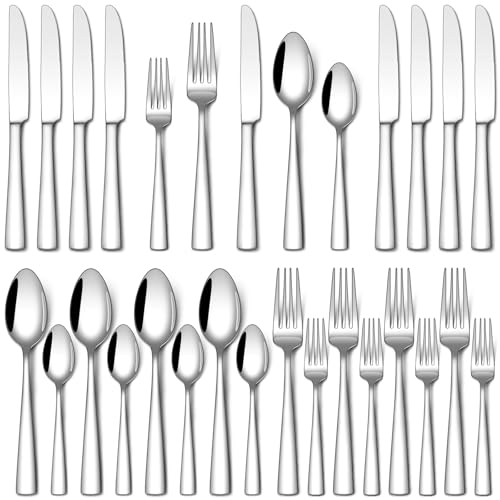
- Set the flatware. Forks go on the left of the plate, with the salad fork outermost if you are serving a salad course. Knives go on the right with the blade facing the plate. Spoons go to the right of the knife. Dessert utensils can go above the plate or be brought out with dessert.
- Place the bread plate and butter knife. The bread plate sits above the forks, and the butter knife rests across it at a diagonal.
- Arrange the glassware. The water glass sits above the knife, with the wine glass to its right. Keep the glassware group tight so guests are not reaching across each other.
- Add the napkin. Fold it into a simple rectangle or triangle and place it on the plate or to the left of the forks.
- Set the centerpiece and condiments. Place your centerpiece in the middle of the table, keeping it low enough to see across. Set salt, pepper, and any serving dishes within easy reach.
Table Setting Checklist
- Tablecloth or runner, centered with even drop
- Placemats or charger plates, one per seat
- Dinner plates, bread plates, and butter knives
- Forks, knives, spoons, and dessert utensils
- Water glasses and wine glasses
- Napkins
- Centerpiece and candles, kept low
- Salt, pepper, serving utensils, and trivets
Spacing and Balance on a Square Table
Symmetry is what makes a square table look intentional. Place each seat so it is centered on its side, and mirror the setting from one side to the next. If you have an odd number of guests, such as five or six on a table designed for four, add a second chair to one side rather than squeezing a third person onto a single edge. Keep the centerpiece in the exact middle so it reads as the focal point from every seat.
Using Diagonal Layouts
On larger square tables, some hosts place the settings on the diagonal rather than straight on each side. This works well for eight guests around a 48-inch table, because it gives each person more room at the corners. Test the layout with a few plates before the guests arrive, and check that no one will be sitting too close to the corner of the table.
Lighting, Serveware, and Finishing Touches
Lighting matters more on a square table than you might think. A single pendant centered over the table keeps the light even on all four sides. If you use candles, place them in a line down the center or as a cluster in the middle, and keep them well clear of the guests’ faces. For serving, use a square or round platter in the center and keep dishes in a single column rather than scattered around the edges, so people can reach them without leaning.
Common Mistakes
- Crowding the corners. The corner of a square table is the easiest place to bump elbows. Keep settings slightly inward from the corners.
- Uneven tablecloth drop. If one side hangs lower than the others, the whole table looks off. Measure each side before you set anything on top.
- Placing the centerpiece too high. A tall arrangement blocks sightlines and makes conversation harder across the table.
- Forgetting elbow room. Seating two people too close on a 36-inch side leads to awkward dinners. Adjust the number of chairs instead.
- Mismatched place settings. Use the same plate, glass, and flatware for every seat. Mixing patterns makes a square table look unfinished.
Tips for Hosting on a Square Table
Serve food from the center and pass plates in a consistent direction so you do not have to reach across guests. If you have a larger group, consider a buffet table with a separate layout for self-serve dishes, or check out how to plan a buffet table layout and traffic flow. For a complete holiday setup, you can also review Round Dining Table Setting: A Step-by-Step Guide for Hosts to compare how the same principles change with a different table shape.
When your table is ready, it helps to plan the rest of the room. The guide to Thanksgiving Seating: Table Layouts for Big Groups in Small Spaces is useful if you need to fit more people into limited space, and Best Tablecloths for Parties and Holiday Tables can help you choose a cloth size that suits a square surface.
Recommended gear
A few supplies make the process faster and the result more polished. These are the items that matter most for a square table.
- Square tablecloth. A cloth sized to your table gives an even drop on all four sides, which is hard to achieve with a rectangular cloth. View on Amazon
- Charger plates. Charger plates anchor each setting and make a formal layout look balanced from every seat. View on Amazon
- Table runner. A narrow runner down the center draws the eye to the middle and helps the centerpiece stand out. View on Amazon
FAQ
How many people fit around a square dining table?
Most square tables seat four comfortably, with one person per side. Larger square tables around 48 inches per side can seat eight if you place two chairs on each side with enough spacing.
Where should the centerpiece go on a square table?
Center it exactly in the middle of the table. Keep it low enough that guests can see each other across the table without leaning.
Should I use a square or round tablecloth on a square table?
A square cloth matches the shape and gives an even drop on all sides. A round cloth can work, but it leaves the corners uncovered and can look less intentional.
How far apart should place settings be on a square table?
Allow about 24 inches of width per guest along each side. Leave room for elbows and make sure chairs can be pulled out without hitting another guest.
Can I set a square table on the diagonal?
Yes. A diagonal layout works well for larger square tables because it gives corners more room. Test it with a few plates first to check spacing.
Which side does the fork go on?
Forks go on the left of the dinner plate. Knives and spoons go on the right, with the knife blade facing the plate.
How high should the chairs be for a square table?
Standard dining chairs with seats 17 to 19 inches high suit a table around 29 to 30 inches tall, leaving a comfortable gap for knees and lap space.
Conclusion
A square dining table setting comes down to symmetry, measured spacing, and a clear plan for each guest. Start with the tablecloth and measurements, then set each place in the same order around all four sides. With a consistent layout and a centerpiece kept low, your square table will look balanced and welcoming for any holiday gathering.
Related reading
Ready to choose one?
About Miles Sinclair
Miles Sinclair is part of our editorial team and reviews and edits our holiday hosting guides, checking product details against manufacturer specifications and owner feedback.