 By Miles Sinclair
Updated November 2026
A round dining table setting comes together faster than most hosts expect once you know the spacing rules. In this guide, you will learn how to measure your table, place every plate and utensil, arrange glassware, and position your centerpiece so each guest has room to eat and talk. Plan for about 24 to 30 inches of width per seat, and you will have a balanced, welcoming table for four to eight people.
Why Round Tables Need a Different Approach
Rectangular tables give you clear end seats and straight edges to line up. Round tables have no corners, so the job is about measuring around a curve. Every place setting needs to sit on the same radius from the center, and the spacing between neighbors should look even from every angle. Hosts who skip this step often end up with crowded seats on one side and empty space on the other.
A round table also changes how conversation flows. Everyone can see everyone else, which makes it easier to talk across the table. That same visibility means your setting should look tidy from all sides, not just the head of the table.
Step 1: Measure the Table and Count Your Seats
Start with the diameter. Measure straight across the top of the table, from edge to edge through the center. Then use the circumference formula (diameter × 3.14) to find the distance around the edge.
Divide the circumference by the number of guests to find the space each person gets along the edge. Most hosts find that 24 inches per person is a comfortable minimum, and 30 inches gives guests room to rest their elbows without bumping neighbors.
| Table Diameter | Approx. Seats (24 in each) | Approx. Seats (30 in each) |
|---|---|---|
| 36 inches | 4 | 3 to 4 |
| 48 inches | 6 | 5 |
| 60 inches | 7 to 8 | 6 |
| 72 inches | 9 to 10 | 7 to 8 |
If your count comes out tight, consider a larger table, a leaf insert, or a second table pushed close by for overflow seating. The Thanksgiving Seating: Table Layouts for Big Groups in Small Spaces article covers layouts for larger crowds in tight rooms.
Step 2: Set Up the Tablecloth and Base Layers
Choose a cloth that drops about 10 to 12 inches past the table edge on a round table. This gives a graceful look without tripping anyone. A round cloth or a square cloth with the corners draped evenly both work well.
If you use a placemat, lay it first. Place it about 1 inch in from the table edge so the plate and mat do not overhang awkwardly. Plan on one placemat per seat, centered on the imagined spoke that points to that chair.
Step 3: Mark Your Seat Positions
Here is the most useful trick for round tables. Fold a piece of paper or use a piece of string, tie one end to the center of the table and mark the radius, then place small markers at equal intervals around the edge. For eight guests, that means marking every 45 degrees. You can also estimate by eye: imagine the table as a clock and place seats at each equal hour point.
Once your markers are down, move them slightly if needed so the seats feel balanced. Mark seat positions before you bring out any dishes. It is much easier to fix spacing with an empty table.
Step 4: Place the Plates and Flatware
Center the dinner plate at each marked position, about 1 inch from the table edge. Keep the plates aligned so the rim of each one sits at the same distance from the edge.
Standard Placement Rules
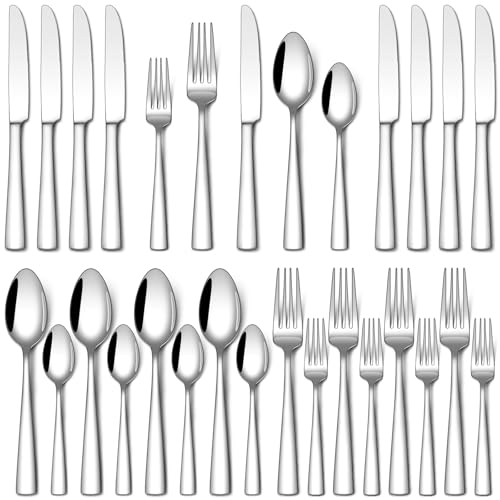
- Forks go to the left of the plate, with the dinner fork on the outside and the salad fork (if used) closest to the plate.
- Knives go to the right of the plate, blade facing inward toward the plate.
- Spoons go to the right of the knife. A soup spoon sits on the outside.
- Dessert utensils go above the plate, with the spoon at the top pointing right and the fork below pointing left, or placed at the time of dessert.
- Bread plate sits to the upper left of the dinner plate, with a butter knife laid across it.
Keep utensils about 1/2 inch above the table edge so they do not dip below the cloth. Use a ruler or the width of your hand (roughly 3 to 4 inches) as a quick spacing check between tools.
Step 5: Arrange Glassware and Napkins
Place the water glass just above the tip of the knife, slightly to the right of center. Add a wine glass to the right of the water glass, slightly lower. For a three-glass setup, place a champagne flute or dessert wine glass on the far right.
Fold napkins into a simple rectangle or triangle and place them to the left of the forks, or in the center of the dinner plate. Napkin folds should be the same on every seat for a consistent look.
Step 6: Build the Centerpiece
A round table has a natural focal point, so the centerpiece matters more than on a long table. Keep the height low, around 12 inches or less, so guests can see each other. Tall arrangements block sightlines and make conversation awkward.
Choose a centerpiece about one-third the width of the table. On a 48-inch table, a 16-inch arrangement works well. For more inspiration, see Holiday Party Centerpiece Ideas: 9 Easy Designs for Any Table.
Step 7: Add the Finishing Touches
- Place salt and pepper shakers within reach of every two guests, or one set per pair of seats.
- Set a small candle or votive along the table edge if you use lighting, keeping flames away from napkins.
- Add name cards at each seat if you are hosting a formal dinner.
- Set a serving spoon or small tray near the center for passing dishes.
- Step back and check the table from a seat, not just from standing. Adjust anything that feels crowded.
Recommended gear
A few tools make round table setups easier to get right on the first try.
- A flexible tape measure helps you find the circumference and spacing without guesswork. View on Amazon
- Round tablecloth sized to your table gives you the right drop on every side with no extra folding. View on Amazon
- Placemats define each seat and protect the table. Choose a size that leaves room for the plate and flatware. View on Amazon
- Table runner or centerpiece tray keeps the middle of the table stable and gives you a clean base for candles or floral arrangements. View on Amazon
Common Mistakes to Avoid
- Crowding the seats. Less than 20 inches per person makes eating uncomfortable.
- Placing the centerpiece too high. Keep it low and compact so guests can see across the table.
- Uneven plate placement. Plates set at different distances from the edge look messy from the side view.
- Forgetting the back of the table. Guests on the far side still see the setting, so keep it consistent all the way around.
- Skipping a test sit. Sit in one chair to check elbow room and sightlines before guests arrive.
Tips for a Stress-Free Setup
Set the table one to two days before the event. Measure and mark seat positions first, then place the plates, then the glassware, and finish with the centerpiece. Keep a spare set of napkins and a lint roller nearby. If you plan a larger spread, sketch the table on paper with the seat numbers so you can refer to it while setting. For drink service planning, the Setting Up a Coffee and Tea Station for Guests guide pairs well with a dinner setup.
FAQ
How much space should each person have at a round table?
Aim for at least 24 inches per person along the edge, and 30 inches if you want generous elbow room for a longer meal.
How many people fit around a 60-inch round table?
Typically six to eight people, depending on how much space you give each guest. Six is comfortable for a relaxed dinner, while eight works for a tighter, more social setting.
How high should a round table centerpiece be?
Keep it under about 12 inches so guests can see each other clearly across the table.
Where do the napkins go on a round table?
Place them on the dinner plate or to the left of the forks. Use the same napkin fold at every seat for consistency.
Should the tablecloth touch the floor on a round table?
A drop of about 10 to 12 inches past the table edge looks balanced and keeps the cloth clear of chairs and feet.
Do I need a placemat under the plate?
It is optional, but placemats define each seat and protect the tablecloth. If you use them, position them about 1 inch from the table edge.
How do I mark seat positions without a ruler?
Imagine the table as a clock and place markers at equal intervals. For six guests, mark every 60 degrees, and for eight, every 45 degrees.
Conclusion
A round dining table setting works best when you measure first, space seats evenly, and keep the centerpiece low. Follow the steps in order, check the table from a seat, and adjust as needed. With a little planning, your guests will have comfortable room to eat and talk.
Related reading
About Miles Sinclair
Miles Sinclair is part of our editorial team and reviews and edits our holiday hosting guides, checking product details against manufacturer specifications and owner feedback.