By Miles Sinclair
Updated November 2026
Table setting fork placement follows a simple rule: forks go on the left side of the plate, in the order your guests will use them, working from the outside in. Once you know that rule, you can set a table for a casual lunch or a formal holiday dinner without guessing. This guide walks you through the basics and the common variations.
The Basic Rule for Table Setting Fork Placement
The dinner fork sits directly to the left of the dinner plate, with its tines facing up. Additional forks go farther out, so the first course is always the outermost utensil. If you are serving a salad before the main course, the salad fork sits to the left of the dinner fork, since it will be used first.
Shopping for one? See our guide: 6 Best Table Setting Knives and Forks for Holiday Hosts (2026).
Forks are always placed on the left because most guests are right-handed and reach for the fork with the left hand while cutting with the right. Keep the tines facing up unless you are setting a formal table with a specific style that calls for them to face down.
Step-by-Step: Setting the Forks
- Place the dinner plate in the center of each cover, roughly one inch from the table edge.
- Set the dinner fork directly to the left of the plate, about one-half inch from the plate’s edge.
- If serving a salad or appetizer fork, place it to the far left of the dinner fork.
- Keep the fork handles about one-half inch above the table surface and parallel to the edge.
- Check that all forks are evenly spaced, with the bottoms of the handles lined up.
Fork Placement for Multi-Course Meals
When you serve several courses, arrange the forks in the order they will be used. The outermost fork is for the first course and the fork closest to the plate is for the main course. Use this layout for a three-course meal:
| Position (left to right) | Fork | Used for |
|---|---|---|
| Outermost | Salad or appetizer fork | First course |
| Middle | Dinner fork | Main course |
| Innermost (near plate) | Dessert fork | Dessert, placed above the plate or brought out later |
A dessert fork can be placed horizontally above the dinner plate with its handle pointing right, or brought in with dessert. Both are correct, so choose whichever suits your table. For more on the dessert option, see Table Setting with Dessert Fork: A Step-by-Step Guide for Hosts.
Adjusting Fork Placement for Casual and Formal Tables
A formal table usually includes only the forks needed for the menu, placed in courses. A casual table can be simpler: a dinner fork and a salad fork is often enough. If you are unsure which style fits your event, Casual Table Setting Placement: A Step-by-Step Guide for Hosts explains how to scale back without losing order.
For a full overview of how forks pair with knives and spoons, Table Setting Silverware Placement: A Step-by-Step Guide for Hosts covers the complete layout. If you are serving a meal that includes a knife with each fork, Fork and Knife Table Setting: A Step-by-Step Guide for Hosts shows how the two sit together.
Common Mistakes to Avoid
- Placing forks on the right side of the plate, which breaks the standard arrangement.
- Setting forks in the wrong order, so the main-course fork sits farther out than the salad fork.
- Crowding too many forks on one side when only two or three are needed.
- Letting fork tines face down on a casual table, which can look unfinished.
- Forgetting to match fork count to the courses on the menu.
Recommended gear
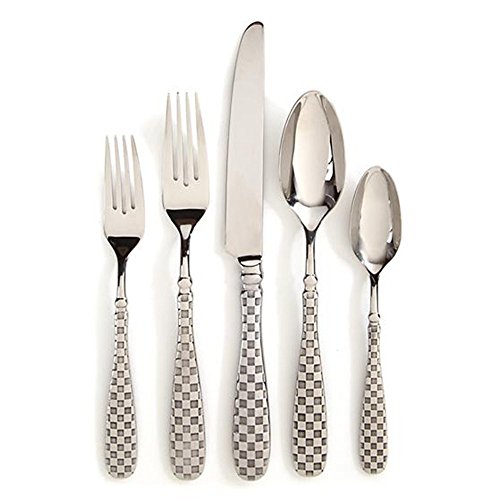
A matching set of dinner and salad forks makes spacing and alignment easier to keep consistent across every place setting. Search for a complete flatware set in your pattern to avoid mixing styles. View on Amazon
A felt or cloth flatware organizer helps you count and store forks by type between events, so none go missing before guests arrive. View on Amazon
FAQ
Do forks always go on the left side of the plate?
Yes, in standard table settings the forks go to the left of the plate. The exception is a dessert fork set horizontally above the plate, which may be placed differently.
Which fork should be placed closest to the plate?
The dinner fork sits closest to the plate because it is used for the main course. Forks for earlier courses go farther out.
Should fork tines face up or down?
On most tables, tines face up. Some formal settings call for tines down, so check the style you are following before you set the table.
Conclusion
Table setting fork placement comes down to one principle: forks go to the left, in the order they will be used, with the first course on the outside. Match your fork count to your menu, keep spacing even, and your table will look organized and easy for guests to navigate. Confirm any specific formal-dining conventions with your event plan before the day.
Related reading
- Table Setting Napkin Placement: A Step-by-Step Guide for Hosts
- Table Setting Knife and Fork Together: A Step-by-Step Guide for Hosts
Ready to choose one?
About Miles Sinclair
Miles Sinclair is part of our editorial team and reviews and edits our holiday hosting guides, checking product details against manufacturer specifications and owner feedback.